In shortThe Rainbow Mountain hike runs 6 to 7 km (3.7 to 4.3 miles) return from the Phulawasipata trailhead at about 4,650 m, climbing roughly 400 to 600 m. Walkers spend 2 to 3 hours on the way up and 1.5 to 2 hours getting back to the car park. A broad valley track leads to a steeper final section and a staircase onto the ridge, which has to be walked.
6-7 km (3.7-4.3 miles)round trip on foot
400-600 mclimb from the trailhead
2-3 hourswalking up
1.5-2 hourswalking back down
How long does the Rainbow Mountain hike take
Budget 2 to 3 hours to get from the car park to the ridge viewpoint, and 1.5 to 2 hours for the way back. Peru's state news agency times the ascent at 90 to 120 minutes, which is what a well acclimatised walker does on a dry morning with no stops for breath. Take the slower end of the range seriously if you landed in Cusco the day before yesterday. On the Cusipata side the walking total, up and back, is quoted at around three hours.
Time at the top is short on a group trip. The guide gives you long enough to walk out along the viewpoint, take your photographs and put the layer back on that you shed on the climb, then starts everyone down so the vehicle can leave on schedule. Few people want longer anyway: the air is thin, the sun is intense and the temperature can drop sharply while you stand still. If you want an unhurried stretch on the ridge, that is an argument for a private departure rather than for arguing with a guide.
| Stage of the hike | Figure from the sources |
|---|
| Trailhead, Phulawasipata parking area | about 4,650 m |
|---|
| Climb to the viewpoint | roughly 400 to 600 m |
|---|
| Round trip on foot | 6 to 7 km (3.7 to 4.3 miles) |
|---|
| Walking up | 2 to 3 hours; state agency gives 90 to 120 minutes |
|---|
| Walking down | 1.5 to 2 hours |
|---|
| Viewpoint altitude | 5,036 m (16,522 ft) catalogued; 5,200 m on the Cusipata registration platform |
|---|
Rainbow Mountain hike distance and elevation gain
The distance is not the problem. Six to seven kilometres return is an easy afternoon anywhere near sea level, and the 400 to 600 m of climbing would be a warm-up in the Alps. The profile here is what changes the maths: you set off at about 4,650 m and stop climbing at a viewpoint catalogued at 5,036 m (16,522 ft), while the Cusipata entry-registration platform and Peru's state news agency both put the site's high point at 5,200 m. Every step is in air with roughly half the oxygen you are used to, which turns a modest gradient into something that stops conversation.
Do this walk if you have had two to three nights at Cusco altitude behind you, Cusco itself standing at 3,399 m (11,150 ft), and you can keep going uphill for a couple of hours ending on a flight of stairs. The CDC asks for mild exercise only in the first 48 hours at altitude and no alcohol in that window, so the mountain does not belong on your first or second day in the city. If you have less acclimatisation than that, are travelling with children under 10, or have heart or back trouble, go to Palccoyo instead: it tops out at 4,971 m and needs 45 to 60 minutes of walking to the summit. Vinicunca is not wheelchair accessible.
The standard full-day departure
Rated 4.9/5 (4062 reviews), this 12-hour trip from $22 handles the road and the meals either side of the walk, and sends a professional guide with oxygen assistance and walking sticks for the climb.
★ 4.9/5 · 4,062 reviews
From the valley track to the final staircase
The first and longest part is a wide track up a broad valley, gently graded, impossible to lose, shared with walkers, horses and the odd herd of alpacas. You gain height slowly here, which is exactly what you want. Walk it slower than feels natural and keep sipping water, because people who race this section pay for it later.
The last part changes character. The track steepens as it bends up towards the saddle, the surface gets loose and stony, and the final metres onto the ridge viewpoint are a staircase. That stretch is where heart rates spike and where most people stop every few steps.
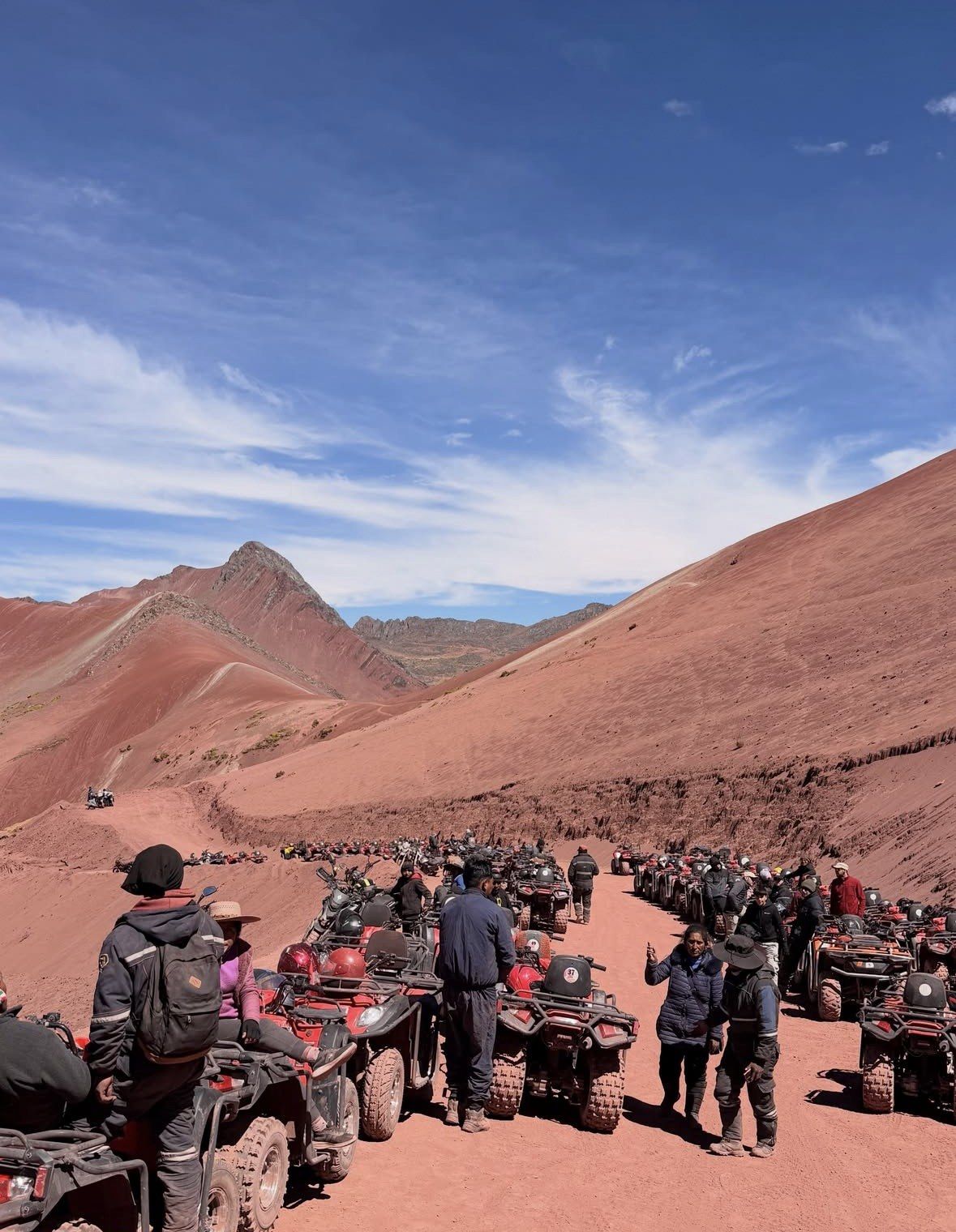
Whatever assisted option you take, the end is on foot. Horses do not reach the viewpoint, and the steep final section and the staircase have to be walked. A quad-bike version of the day also runs among the tours on this site, 13 hours door to door with the Red Valley in the itinerary, oxygen and a first-aid kit on board. The quads cover part of the valley track; the climb onto the ridge is still yours to walk. Wear boots or trainers with grip, and use the walking sticks if your tour provides them.
How a guided day is paced
Collection from your hotel happens in the dark, anywhere from about 3:00 to 4:30 am with 4:00 am the usual slot, and operators warn the time can move by 30 to 45 minutes while the vehicle works through its list. Breakfast is served on the way, the drive ends at the trailhead, and you start walking at first light. After the descent comes lunch, then the same road back, with drop-off in Cusco around 5 to 6 pm. Counting the dark start and the return leg, you are committed for about 12 to 14 hours to do a walk of roughly three.
That brutal start buys you the two things that matter. You will be on the ridge while the bands are at their most saturated, which happens between 5 and 10 in the morning, and ideally off it before the 9:30 am to midday crush, when the standard departures out of the city converge on the viewpoints. Arriving before that window, or deliberately after it, is the difference between a quiet ridge and a queue at the photo spot. Reported hours on both access routes are 6:00 am to 5:00 pm, but the constraint that bites a walker is the trail admission cut-off, which one Cusco operator puts at 2 pm, so confirm it with the operator if you are weighing a later start.
The short extension to the Red Valley viewpoint
Next door to the Vinicunca ridge sits the Red Valley, a separate viewpoint reached by a short extra walk from the main trail. It is a different thing to look at, deep rust-red slopes rather than banded stripes, and it has its own community entrance that is charged separately from the Vinicunca ticket. Most itineraries treat it as a decision taken on the day, once you know how your legs and lungs are holding up.
Say yes if you are moving well and the weather is clear, and say no without guilt if the climb to the ridge has already emptied you. The extension adds walking at the same altitude and stretches an already long day. Among the tours on this site, the Premium day trip includes the Vinicunca and Cusipata entrance and keeps the Red Valley optional, while the cheapest full-day excursion leaves both entrances to settle and the Red Valley open as a choice.
Rules on the trail and at the viewpoint
Access is run by the peasant communities on both sides of the mountain, Chillihuani in Cusipata district and Pampachiri in Pitumarca, and community members work as guides and muleteers. There is no visitor centre up there, no published phone number and nobody to appeal to if you break the rules, so treat the posted conduct as binding.
- Stay on the marked trail, including on the steep final section where shortcuts cut the slope apart.
- Leave the apachetas, the sacred stone cairns, exactly as you find them.
- Carry your rubbish back down with you.
- No drones without a permit.
- Keep well back from the drop-offs when you are framing a shot on the ridge.
- Under-10s are better left off this particular climb, and no part of the route is wheelchair accessible.
Questions people ask
How busy will the trail be while I am walking?
Expect to share the track with up to 1,500 people a day through the May to October high season and around 600 a day when it is quiet, and Peru's state agency has reported figures of up to 2,000 a day since the site opened to tourism. They are not spread evenly: the viewpoints fill between 9:30 am and midday. Nowhere in the Cusco region pulls bigger numbers except Machu Picchu.
Which months make the walk easiest?
May to October is the dry window named by Peru's state news agency, with operators widening it to April to October and calling May to September ideal. From November to April rain and snow can cover the bands and slow the road to the trailhead. Dry-season dawns are cold: mean daily minima at Cusco airport, 3,249 m, drop to 1.2 °C in July and 1.9 °C in June, and the mountain is much higher, so bring layers and sun protection in any month.
Can children do the hike?
Children are technically admitted, but the walk is not recommended under 10 years of age. The combination of a pre-dawn transfer, 400 to 600 m of climbing above 4,650 m and a staircase at the end is a lot for small legs. For a family, Palccoyo asks only 45 to 60 minutes on foot to reach its summit at 4,971 m, which is the version small children actually manage.
What happens if I feel ill on the way up?
The thing to watch for on the climb is headache, the cardinal symptom of acute mountain sickness; it usually arrives with at least one of anorexia, dizziness, fatigue, nausea or occasional vomiting, and it tends to show up 2 to 12 hours after you gain altitude. Tell the guide rather than pushing on. The CDC advice is to descend if symptoms worsen, with improvement usual after 300 m or more of descent, and the tours on this site carry oxygen and a first-aid kit.
Could the mountain be closed on the day I walk?
In principle the site runs every day of the year, with the exception of closures for natural disasters or social disruption, and those exceptions are not theoretical. February 2026 is the case to keep in mind: heavy rain and snowfall left access bridges damaged and a temporary suspension went under evaluation, a decision that sits with the Pitumarca and Cusipata municipalities together with the regional tourism office. Because access is community-run there is no single status page, so reconfirm with the operator the night before.
Read also