In shortThe best time to visit Rainbow Mountain is May to September, the stretch operators name as ideal for clear skies and strong colour, sitting inside the May to October dry season given by Peru's state news agency. Those months are also the busiest, with up to 1,500 visitors a day against around 600 in low season. Dates falling between November and April carry the risk that snowfall and rain hide the stripes altogether and shut off the way up.
May to Septemberideal months for colour
1,500 a dayhigh-season visitors
600 a daylow-season visitors
6 am to 5 pmreported daily hours
Aim for May to September, the window operators call ideal
Book inside May to September. Peru's state news agency names May to October as the best season for the coloured mountains, and operators who drive the road every week narrow it to May through September for clear skies and strong colour. In those months a dry morning on the ridge is the usual outcome.
April and October are the workable edges of that window. Operators stretch the dry season across both, and neither sits in the heaviest weeks of traffic. January to March is the stretch to avoid, and February most of all.
What the dry season gives you, and what it costs
The rainfall record from the nearest long-run station, Cusco airport at 3,249 m, shows how sharp the split is. January averages 153.4 mm over 19.6 days with at least 1 mm. June averages 3.3 mm across a single such day, and July 1.2 days. Annual totals put those months in proportion: about 727.7 mm of precipitation and 106.1 rain days, with the bulk of them packed into November to March.
The price of that dryness is the cold at the start. Mean daily minima at the same station fall to 1.2 °C in July and 1.9 °C in June, and you begin walking far above where the station sits. Maxima hardly shift across the year, from 20.3 °C in February to 22.3 °C in November, so the month you pick changes how cold the pickup is more than how warm the afternoon gets. Official reporting on conditions at the site is blunt for every month: thin air, intense sun, temperatures that can drop sharply. Layers and sun protection go in the bag in July and in January.
Glaciers capped Vinicunca until the ice melted away by around 2013, which is why the coloured strata now lie bare to whatever the weather does.
| Window | Months | What to expect |
|---|
| Ideal for colour | May to September | The months operators name for clear skies and strong colour; driest weeks of the year |
|---|
| Wider dry window | April to October | Operators count the whole stretch as dry season; April and October are quieter at the viewpoints |
|---|
| Season named by Peru's state agency | May to October | The recommended season, and also the high season, running to 1,500 visitors a day |
|---|
| Wet season | November to April | Snowfall and rain can hide the stripes and shut off the way up; longer transfer times to the trailhead |
|---|
The dry-season full day from Cusco
Once the month is settled, the booking is the simple part: a 12-hour day from $22, rated 4.9/5 (4062 reviews), covering the drive and the meals on both sides of the walk, with oxygen assistance and walking sticks carried by the guide. Cancellation stays open up to 24 hours before.
★ 4.9/5 · 4,062 reviews
The clearest months are also the busiest
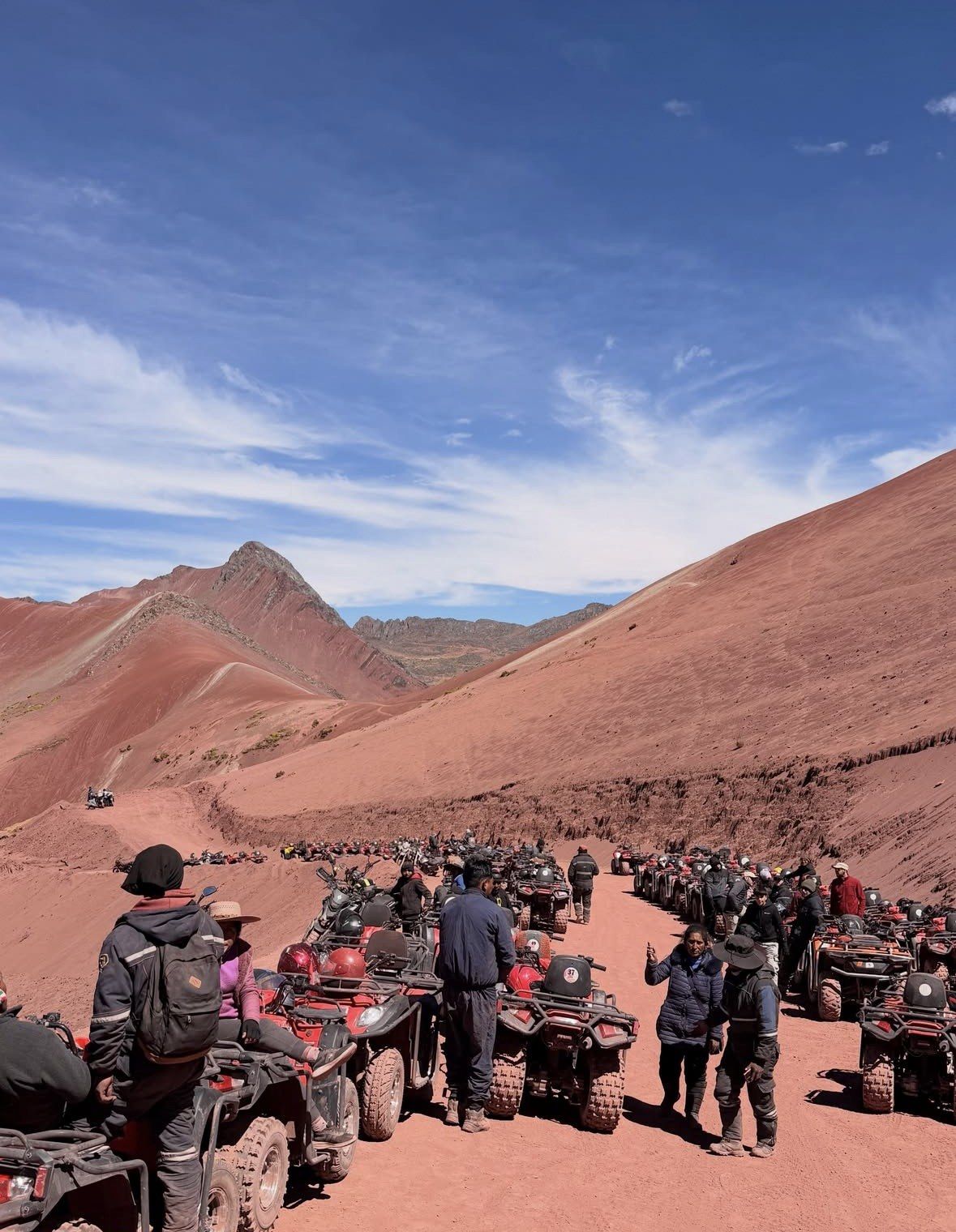
High season, May to October, runs to 1,500 people a day at the site. Once the rain sets in, that figure drops to around 600. Peak days have gone higher still: up to 2,000 people in one day at any point since tourism began here, according to Peru's state agency. Only Machu Picchu pulls more visitors anywhere in the Cusco region.
Timing inside the day decides what the crowd costs you. Colour and crowds run on separate clocks: the strongest colour falls between 5 and 10 in the morning, while the viewpoints fill from 9:30 am to midday, when the standard city departures all pull in at once. A June or July date with a small-hours pickup puts you on the ridge for the colour and on the way down as the buses arrive.
The fullest weeks fall in the middle of the dry season, when Cusco's festival calendar and school holidays in both hemispheres land on the clearest skies. If your dates can move, shift towards the start or the end of the dry window and keep the early departure either way.
- May and September: dry weather with less of the mid-season pressure on the viewpoints
- June, July and August: the most reliable skies and the fullest trail
- April and October: shoulder months, drier than the wet season and quieter than July
- Any dry-season date: take the pre-dawn pickup rather than a mid-morning start
November to April brings cloud, snow and suspended access
Between November and April, snow and rain can sit on the coloured slopes, which makes the top harder to reach and the bands flat or invisible. Peru's tourism board warns that road travel to the trailhead gets much slower in the rainy season, and that stretches a day already built around a long drive.
Take February 2026 as the worked example of a wet-month date. Heavy rain and snowfall damaged bridges on the access roads, and authorities evaluated a temporary suspension of visits. A closure of that kind is decided jointly by the Pitumarca and Cusipata municipalities with the regional tourism office, so there is no single page to refresh. Wet-month minima are milder, near 7.6 to 8.0 °C from November to February.
If your trip only lands in those months, reconfirm with the operator the night before, and accept that you may lose the day rather than drive three hours to a snowed-out mountain.
Open every day, with hours that shape your morning
The site works every day of the year, with one written exception: exceptional closures for natural disasters or social disruption. Both access routes are reported to run from 6:00 am to 5:00 pm, and the ticket is reported valid only on the route where it was issued, so the side you use is settled before you leave the city.
The constraint that bites a walker is the cut-off for starting the trail: one Cusco operator states that visitors are admitted only until 2 pm. Neither the hours nor that cut-off appears on a government page, so confirm both with the operator when you book a later start. With 2 to 3 hours up and 1.5 to 2 hours down, an afternoon admission leaves very little margin inside the closing time.
Fix the month, then book the trip
Pick a date between May and September, or April or October if that is what the calendar allows, then choose the format. The standard full day from Cusco is the plain version: 12 hours door to door, from $22, rated 4.9/5 (4062 reviews), with the Red Valley left open as a choice on the day and cancellation open up to 24 hours before if the forecast turns against you.
For a short trip that has to cover both of the region's most visited sights, the two-day Machu Picchu and Rainbow Mountain itinerary runs from $795, rated 5.0/5 (86 reviews), in a small group or private, sequenced so the 2,430 m citadel falls either side of the high-altitude day. Whichever you take, spend two or three nights at Cusco's 3,399 m before the mountain morning.
Questions people ask
Is June or July the best month to visit Vinicunca?
Both sit in the driest part of the year and either one works. June records 3.3 mm of rain and 1.0 day with at least 1 mm at the Cusco airport station; July, 1.2 such days. The difference shows up at dawn: mean minima bottom out at 1.2 °C in July and 1.9 °C in June, so dress for near-freezing at the pickup.
Can you still go in February?
Technically yes, since the site operates every day apart from exceptional closures, but February is the month to skip. It averages 17.2 days of rain of at least 1 mm and the year's lowest daily maximum at 20.3 °C, and in February 2026 a temporary suspension of visits was under evaluation after heavy rain and snowfall damaged access bridges.
How likely is a closure during the dry season?
Closures are rare, and the dry months are when they are least likely. The site opens every day of the year apart from exceptional cases such as natural disasters or social disruption, and any suspension is agreed between the Pitumarca and Cusipata municipalities and the regional tourism office. Reconfirm with the operator the evening before, whatever month you travel in.
What time of day should I aim to be at the viewpoint?
Before 9:30 am. The colours are most vivid between 5 and 10 in the morning, and foot traffic peaks from 9:30 am until midday, when the standard departures from the city arrive together. That is why hotel pickups in Cusco sit in the small hours, anywhere from about 3:00 to 4:30 am with 4:00 am the usual time, on a day that totals roughly 12 to 14 hours.
Is the visit covered by the Cusco Tourist Ticket?
No. The Boleto Turístico leaves the mountain out: its S/130 integral version stretches only to three circuits of sites in the city, the Valle Sur and the Sacred Valley. The local communities control access at the trailhead, and whether that entrance is covered depends on the individual tour you book.
Read also