In shortCusco is the base: tours collect you from a hotel in the city centre between about 3:00 and 4:30 am. The Historic Centre around the main square is the simplest choice, San Blas is quieter but uphill, Wanchaq and the outer districts are calmer again. Book the room for two or three nights before the mountain day, because the city you are sleeping in stands at 3,399 m (11,150 ft).
3,399 m (11,150 ft)Cusco sleeping altitude
3:00 to 4:30 amhotel pickup window
1.2 °CJuly mean dawn minimum
2,870 m (9,420 ft)Urubamba, Sacred Valley
Where to stay in Cusco for the Rainbow Mountain day
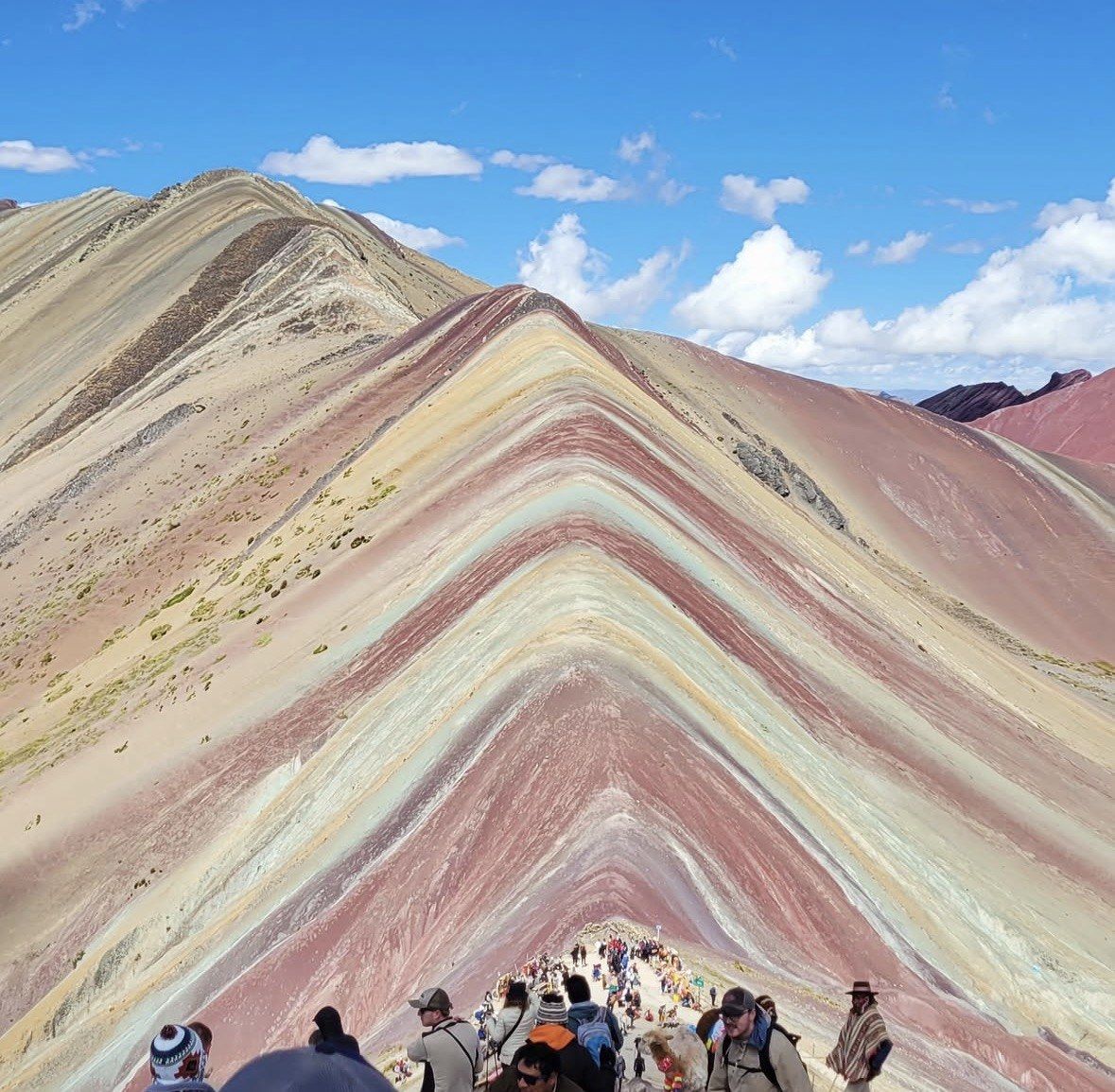
Cusco is the practical base for Vinicunca. The coloured mountains lie a little over 100 kilometres south-east of the city, the Cusipata–Phulawasipata route totals 109 km, and the shortest standard approach is roughly a two-hour drive followed by a walk of about 5 km. That is why the standard trip from the city is listed at 12 hours, and why the day starts while the square is still empty: hotel pickups run from about 3:00 to 4:30 am, 4:00 am on most departures, and operators warn the time can move by 30 to 45 minutes.
The pickup on the standard full day is listed as coming from a hotel in the city centre, so the closer you sleep to the main square, the less there is to arrange at that hour. Some itineraries work differently: one asks guests to meet the guide in the centre of the square, and one ends with drop-off on Avenida El Sol in front of Qorikancha rather than at the door of your hotel. Check which applies before you choose a neighbourhood.
Allow three nights in the city before the mountain morning, or split them with two lower nights in the Sacred Valley and two in Cusco. Your room booking is the acclimatisation plan: the CDC puts the first two to three nights at around 2,450 to 2,750 m and allows mild exercise only and no alcohol over the first 48 hours, while Cusco's 3,399 m (11,150 ft) already sits above that entire band, so every night on the reservation counts. Keep Vinicunca for after 48 to 72 hours in town.
The standard full day from a city-centre hotel
This is the departure that matches a central address: the vehicle comes to your hotel in the city centre, the day is listed at 12 hours from $22 and rated 4.9 ★ (4062 reviews), breakfast and lunch are on the road, walking sticks and oxygen assistance come with the guide, and the booking can be cancelled up to 24 hours before departure.
★ 4.9/5 · 4,062 reviews
The best area to stay in Cusco is the Historic Centre
Peru's tourism board names the Historic Centre, the artisan neighbourhood of San Blas and San Pedro Market as the central areas visitors use, and the first of those is the easiest base for a trip that leaves before dawn. Everything you need on arrival day is within a slow walk: the main square, pharmacies, the market, the Qorikancha end of Avenida El Sol where some tours drop off. Walking slowly matters more than it sounds, because the centre is built on a slope and the cobbles around the square climb in every direction.
The trade-off is noise. The streets ringing the square carry bar and restaurant traffic late, and your alarm will go off around 2:30 am for a 3:00 am pickup. Ask for a room facing an interior courtyard rather than the street, and tell reception the night before what time a vehicle is coming for you.
For a vehicle, a central address is the simplest thing to describe to a driver in the dark. If you are deciding where to stay in Cusco purely around the mountain day, this is the area that asks least of you.
San Blas and the lanes above the square
San Blas is the artisan quarter and, with Santa Clara, one of the historic neighbourhoods where Spanish and Inca stonework sit on the same wall. Nights are quieter than on the square and the views over the roofs are the reason people book here. The catch is the gradient: the lanes run up and away from the centre on narrow, stepped streets, and every return from dinner is a climb at 3,399 m.
On arrival day that climb works against the CDC's advice to keep to mild exercise for the first 48 hours, so take a taxi with luggage instead of walking it up. For the mountain morning, confirm with the operator exactly where the vehicle will wait, since the upper lanes are narrow and the stop may be a short walk from your door.
Wanchaq and the quieter residential districts
Cusco city is made up of the districts of Cusco, San Jerónimo, San Sebastián, Santiago and Wanchaq. The four outside the historic core are residential, flatter in parts, and much quieter after dark, which is worth something when you are trying to sleep by nine for a 3 am start. You also avoid the late noise of the square entirely, and you are not tempted into the first-night drinks that the CDC tells you to skip for 48 hours.
Two things to settle before booking out there. The walk into the centre is long and uphill in places, so budget taxis for it rather than legs you want fresh for 400 to 600 m of climbing above 4,650 m. And because the standard full day lists pickup from a hotel in the city centre, ask if your address is inside the pickup area or if you have to reach a meeting point in the middle of the night.
Sleeping lower: the Sacred Valley option
If thin air is the thing you are worried about, spend your first nights on the valley floor instead of in the city. Every bed in the Sacred Valley sits lower than every bed in Cusco. The floor starts at about 3,000 m (9,800 ft) by Pisac and keeps dropping to 2,050 m (6,730 ft) on the river below Machu Picchu, and the two towns travellers actually book are Urubamba, about 2,870 m (9,420 ft) and roughly an hour from the city, and Ollantaytambo, 2,792 m (9,160 ft) and about 72 km by road north-west of Cusco.
Split the reservation, two nights in the valley and then one or two in Cusco, and you reach 3,399 m in one step late in the week rather than on arrival, which is what the CDC's numbers ask for: no more than about 500 m of extra sleeping altitude per night above 3,000 m, and one additional acclimatisation night for every 1,000 m of sleeping altitude gained. Mild symptoms usually appear 2 to 12 hours after you gain height, often during or just after the first night, which is why many travellers land in Cusco and transfer down the same afternoon.
Do not sleep in the valley the night before Vinicunca. Pickups are from Cusco hotels between about 3:00 and 4:30 am and the drive to the trailhead is another two to three hours, so the valley is for the early part of your stay. If symptoms are with you in the city, stay put rather than going higher, and remember that acute mountain sickness usually improves after 300 m or more of descent.
| Where you sleep | Altitude | Note |
|---|
| Cusco | 3,399 m (11,150 ft) | where the mountain pickups start, from about 3:00 to 4:30 am |
|---|
| Pisac, valley floor | about 3,000 m (9,800 ft) | the high end of the Sacred Valley |
|---|
| Urubamba | about 2,870 m (9,420 ft) | largest valley town, roughly an hour from Cusco |
|---|
| Ollantaytambo | 2,792 m (9,160 ft) | about 72 km by road from Cusco, train gateway |
|---|
| River below Machu Picchu | 2,050 m (6,730 ft) | the lowest point on the valley floor |
|---|
What to look for in a room for cold nights and a 3 am start
Cusco's cold is a night-time problem rather than a daytime one. The figure to book a room against is the dawn one: the airport station at 3,249 m records mean daily minima of 1.2 °C in July and 1.9 °C in June, while the daily maximum stays between 20.3 °C in February and 22.3 °C in November whatever month you arrive in. In the wet months, November to February, minima stay near 7.6 to 8.0 °C.
- Heating or extra blankets, and a hot shower that works before dawn, if you are travelling in June or July when dawn averages 1.2 to 1.9 °C.
- Someone awake at reception at 3 am, because the earliest pickups start then and can shift by 30 to 45 minutes.
- A quiet room away from the street, so a 2:30 am alarm follows real sleep.
- Space to lay out layers and sun protection the night before: on the mountain the air is thin, the sun is intense and temperatures can drop sharply in any month.
- Somewhere to dry clothes if you travel between November and April, when January alone averages 153.4 mm of rain over 19.6 days against 3.3 mm in June.
- Do not pay extra for a hotel breakfast on mountain day. The standard full day from Cusco includes breakfast and lunch on the road, and you will be gone long before the dining room opens.
Questions people ask
Should I sleep in the Sacred Valley the night before Rainbow Mountain?
No. Your bed has to be in the city that night, because the vehicle arrives at a Cusco hotel somewhere between about 3:00 and 4:30 am and there are still two to three hours of driving to the trailhead after that. Use the valley's lower beds, Urubamba at about 2,870 m (9,420 ft) or Ollantaytambo at 2,792 m (9,160 ft), earlier in your trip, then move back up to the city for the night before the mountain.
Does the two-day Machu Picchu and Rainbow Mountain itinerary include my Cusco hotel?
It does not. The listing covers private-vehicle transport, hotel pickup and drop-off, a professional guide and meals as per itinerary, with breakfast, lunch and a snack on the Rainbow Mountain trek day. Overnight accommodation in Cusco between the two tours is excluded, as are meals during the Machu Picchu part, so book a central room for that night yourself.
Which months need the warmest room in Cusco?
June and July. Mean daily minima at the Cusco airport station (3,249 m) fall to 1.9 °C in June and 1.2 °C in July, the two coldest dawn months and also the heart of the dry season for the mountain. Daytime highs hardly change across the year, between 20.3 °C and 22.3 °C, so the cold you have to plan for is the cold you meet at the pickup.
What if altitude symptoms start on my first night in the city?
Acute mountain sickness starts with a headache, normally alongside loss of appetite, dizziness, fatigue or nausea, and the usual window is 2 to 12 hours after the climb, which lands it in your first night in the room. Stay at the same elevation or go lower, and never ascend to sleep higher while you have symptoms. Descending 300 m or more usually brings improvement, and the standard full-day tour can be cancelled up to 24 hours before departure if you need to move your plans.
How long should I book my Cusco room for in total?
Think in nights before the mountain rather than days in town. Two to three nights at Cusco altitude ahead of the high day is the working minimum, and the trip itself eats a full 12 hours with a small-hours start, so a four-night booking gives you arrival, two settling days, the mountain and a quiet morning after it. Add a night if you also want the Sacred Valley or the citadel in the same week.
Read also